
There are posters, and then there are images that define a moment. Shepard Fairey’s HOPE portrait of Barack Obama is in the second category — and to understand why a single print can list for thousands of dollars today, you have to understand where Fairey came from, how this image was made, and what it came to represent.
The artist
Frank Shepard Fairey was born in Charleston, South Carolina, in 1970 and came up through skateboarding culture, putting his drawings on skateboards and T-shirts as a teenager. He studied at the Rhode Island School of Design, earning a BFA in illustration in 1992.
His breakthrough was almost an accident. In 1989, while at RISD, Fairey was teaching a friend how to make a stencil and pulled a newspaper ad featuring wrestler André the Giant. The joke stencil became “Andre the Giant Has a Posse,” a sticker campaign friends spread from wall to wall. It evolved into OBEY Giant — a deliberately mysterious image with no single message, meant to make people stop, react, and question the propaganda, advertising, and authority they walk past every day. That experiment became Fairey’s lifelong visual language: bold stencils, high contrast, a limited palette, and imagery borrowed from propaganda posters. It also grew into the OBEY name, a major museum career — his work is held by the Smithsonian, MoMA in New York, LACMA, and the Victoria and Albert Museum in London, among others — and a first major U.S. museum retrospective, Supply & Demand, in Boston in 2009.
In short, Fairey was never a conventional campaign artist. He was a street artist who understood how an image spreads when ordinary people, not institutions, carry it.
The artwork
HOPE began independently, not as an official campaign commission. In late 2007, Fairey discussed supporting Obama with publicist Yosi Sergant. The campaign gave permission a few weeks before Super Tuesday, and Fairey designed the portrait in a single day.
He based it on an April 2006 photograph of then-Senator Obama taken by freelance photographer Mannie Garcia for the Associated Press, which Fairey found through an image search. He transformed that news photo into a stylized stencil portrait in solid red, beige, and light and dark blue — Obama gazing upward and to the side, above a single word. Early versions used “PROGRESS.” The best-known version says “HOPE.” Others in the family said “CHANGE.”
Fairey printed it first as a street poster and sold the first run himself. Then it escaped his control, in the best possible way. Supporters downloaded it, reprinted it, and put it on stickers, signs, T-shirts, and walls. By July 2008, more than 200,000 vinyl HOPE stickers had been printed, most given away. The Obama campaign, seeing an image its supporters had already adopted, embraced versions of it.
That history also includes a serious controversy, and collectors should know it. After the election, the AP sought compensation for Garcia’s photograph. Fairey sued, arguing fair use. The parties settled in January 2011. Fairey later pleaded guilty in 2012 to criminal contempt for destroying and fabricating evidence about which photo he had used, receiving two years of probation, 300 hours of community service, and a $25,000 fine. The case remains a landmark argument about appropriation, photography, and fair use in art.
Why it matters
HOPE’s significance is not just that it was popular. It changed what political art could do in the internet age.
Visually, it gave a campaign a face that was not a flag, a logo, or a posed official portrait. It looked like street art, because it was street art — and that signaled youth, independence, and a break from traditional politics. Critic Peter Schjeldahl in The New Yorker called it “the most efficacious American political illustration since ‘Uncle Sam Wants You’.”
Culturally, it may have been the first presidential portrait to truly go viral. It spread through downloads and social sharing, and then spawned endless variations, imitations, and parodies — a template we now take for granted for political images in the social media era.
Institutionally, the art world ratified that popular verdict unusually fast. On January 7, 2009, the National Portrait Gallery acquired a HOPE portrait, and an edition now hangs at the Smithsonian. Fairey’s image had moved from a street poster to a museum wall in just over a year.
That combination — street origin, viral spread, museum acquisition, and a major copyright fight — is exactly why HOPE is a significant work in the history of American political art, and why it remains collectible today.
The listing
Which brings me to the print that prompted this post.
Currently offered on eBay is a 2008 HOPE screenprint described as a signed Artist’s Proof, marked “AP” on the bottom left and signed in pencil on the bottom right. It is 36 inches by 24 inches, and the seller states it is a second edition of 450 Artist’s Proofs. The listing shows the print in its original packing tube, which the seller describes as having been kept in a climate-controlled environment.
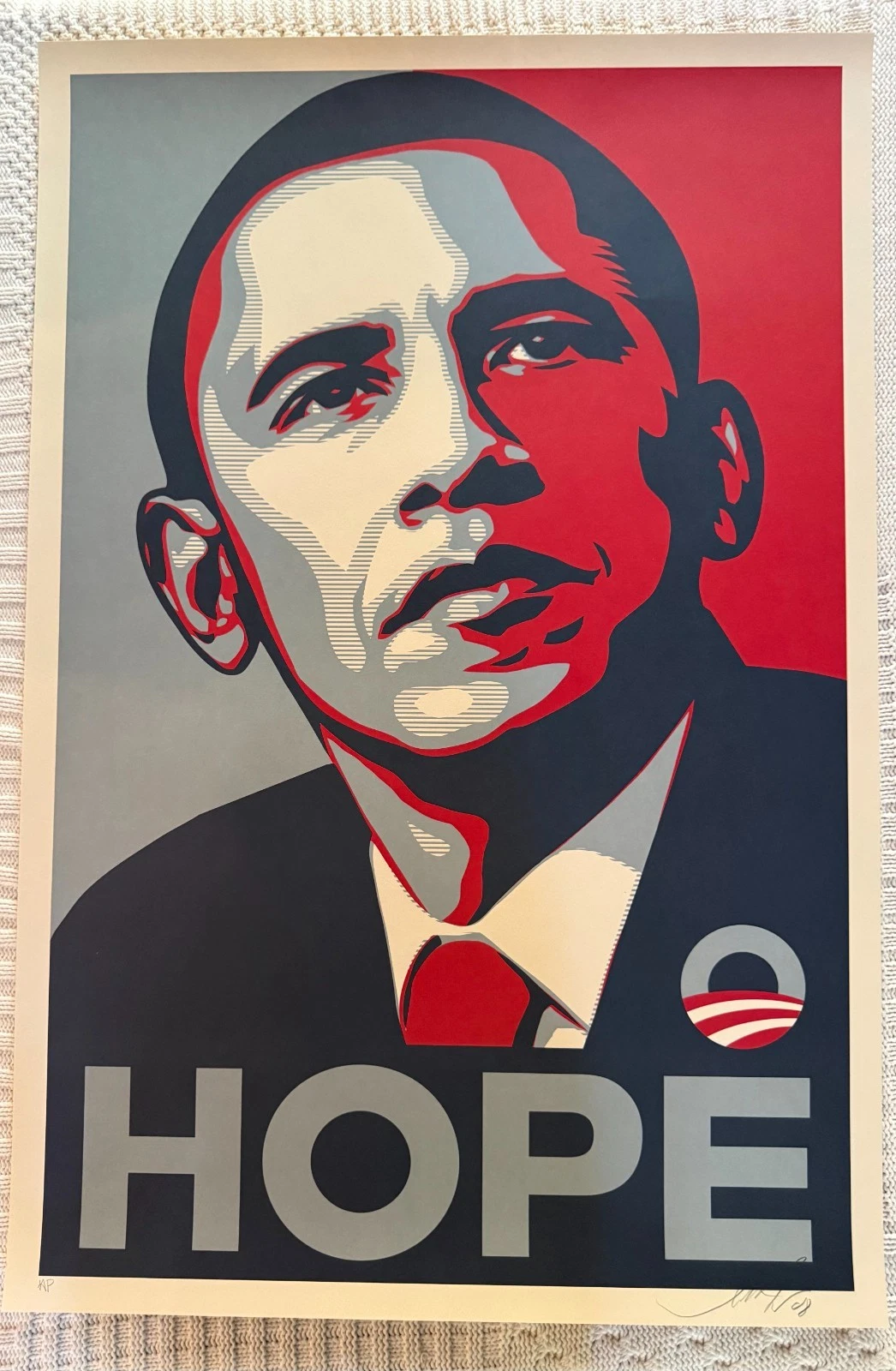
You can see the listing here: Shepard Fairey Obama HOPE 2008 Signed Artist’s Proof on eBay
The asking price is $4,200 or Best Offer, plus $8.38 for UPS Ground shipping from Woodland Hills, California. At the time of this post, it is the only listing I found for a signed 2008 HOPE Artist’s Proof in this format.
An Artist’s Proof adds another layer for a work with this history. Proofs are typically set aside for the artist, the publisher, or the printer, outside the numbered edition. For a print that began as a freely distributed street poster, the idea of a signed Artist’s Proof is a reminder of how HOPE moved from a public image to a collectible object.
And I want to be clear about that practical part. This listing states there is no Certificate of Authenticity (COA) included. As with any high-value print, buyers should review the listing photographs, ask the seller any questions about provenance, and confirm that any signature, marking, or edition details match what is described before making an offer.
Whether it sells at asking price or on a best offer, listings like this test what that moment is worth to collectors now — and whether a work that once belonged to everyone can still command a premium as a singular object.
If you collect political art, street art, or Obama memorabilia, this one is worth a careful look.
